Clinic Students File Comments on Behalf of Small Inventors in USPTO’s Enhancing Patent Quality Proceeding

11156137_10153328852473304_5142884356722722056_n

In May 2015, student attorneys Raph Younghoon Kim, Sarah Frank, Alexandra El-Bayeh supervised by clinic alum and patent attorney David Grossman and Professor Victoria Phillips submitted a comment to the United States Patent and Trademark Office (“USPTO”) on behalf of the United Inventors Association of America (“UIA”), with respect to the proposed automated pre-examination search system (“APEx”) under Proposal 2 of Pillar 1 on Enhancing Patent Quality.  The USPTO is currently considering adoption of an automated prior art search system to assist patent examiners in more effectively and efficiently locating prior art.

The team proposed that the USPTO initiate a pilot program granting small independent inventors online access to APEx when available.  Making APEx available online will provide invaluable assistance to these small inventors in locating prior art before filing a patent application and help them draft better quality applications, which will result in higher quality patents. With online access to APEx, independent inventors will identify patentability issues using prior art listed in APEx online, and thus file higher quality applications. Independent inventors will make these determinations before filing, and protect themselves from investing in poor quality applications. Consequently, the USPTO will receive fewer, but higher quality, applications. This would in turn reduce examiners’ time and resources now wasted on conducting research and preparing Office Actions for applications anticipated by prior art.

The team also proposed that if the pilot is successful, the USPTO should make the  APEx system publicly available and freely accessible online to all. Publicly available online access to APEx would reduce prior art search costs, allow all potential inventors better navigate the patent prosecution process and lead to higher quality patents. Granting the public online access to APEx would also serve as a model for promoting the administration’s ongoing openness and transparency initiatives.

The comment is published on the USPTO website: (http://www.uspto.gov/patent/laws-and-regulations/comments-public/comments-request-comments-enhancing-patent-quality).

Posted in Clinic News | Tagged , , , , , , , , , , | Comments Off on Clinic Students File Comments on Behalf of Small Inventors in USPTO’s Enhancing Patent Quality Proceeding

Clinic Students Propose USPTO Reforms to Discourage Frivolous Trademark Oppositions

Clinic student attorneys Charles Frank and Breanne Hoke, in conjunction with students from the Samuelson-Glushko Technology Law & Policy Clinic at the University of Colorado Law School and the Intellectual Property and Entrepreneurship Clinic at Suffolk University Law School, embarked on a policy effort aimed at discouraging frivolous claims in trademark opposition proceedings before the Trademark Trial and Appeal Board (TTAB). The collaborative clinic effort seek to combat both trademark bullying and trademark trolling through administrative reform.

In March 2015, the students met with several representatives of the United States Patent and Trademark Office (USPTO) at its headquarters in Alexandria, Virginia, where they provided the agency with a “one-pager” that outlined the team’s proposals. The one-pager included a proposal for a “second look” review, an intermediary step between the examination and opposition proceeding stages that would act as a simple, fast, and cost-effective way of addressing frivolous lawsuits and allow a party to note the vigorous defense of its trademark.

In May 2015, the students submitted a white paper to the agency as a follow-up to the March meeting. The white paper expands on the  “second look” review, and provides a comprehensive strategy for employing the review should the USPTO choose to adopt it.  The clinics plan to follow up with the agency on next steps.

White Paper

Posted in Clinic News | Tagged , , , , , | Comments Off on Clinic Students Propose USPTO Reforms to Discourage Frivolous Trademark Oppositions

C’mon Man–Change the Mascot– Federal Court Throws Out Pro Football’s Constitutional Challenges and Orders Cancellation of Federal Trademark Registrations for Washington Football Team

images[1]

Today, the District Court for the Eastern District of Virginia issued its rocket-docket decision in Pro-Football v. Blackhorse and affirmed the Trademark Trial and Appeal Board’s (TTAB) decision to cancel the team’s six team name trademark registrations on the ground that they are disparaging to Native Americans under federal trademark law.   Judge Gerald Bruce Lee rejected each of the football team’s arguments and defenses and ordered that the trademark registrations be cancelled.  Although the case has been litigated for over two decades with numerous decisions by both the TTAB and federal courts in the DC and Fourth Circuits, this case represented the biggest challenge in the dispute as the team mounted strong constitutional challenges to the cancellation in its appeal. 

 The team  argued that the Lanham Act’s prohibition on the registration of disparaging marks is a violation of the First Amendment.  Judge Lee found that the First Amendment was not implicated in trademark registration decisions since these decisions to do not restrict persons from speaking or using their trademarks.  He ruled that trademark registration constitutes government speech, not private speech under the factors laid out in the Supreme Court’s June decision in Walker v. Texas Division, Sons of Confederate Veterans. The team also argued that the statutory provision was unconstitutionally vague and that a cancellation of a registration under the provision was an unconstitutional taking.  Lee dismissed these arguments finding that a trademark registration is not considered property under the Fifth Amendment and that the bar to registration of such marks gives applicants fair warning of what is prohibited.  In addition, he found that the doctrine of  laches did not bar cancellation of the marks as petitioners did not unreasonably delay in filing suit upon reaching the age of majority.  Lee also held that laches does not apply in cases in which there is an overriding public interest.  He then granted petitioners’ motion for summary judgment on the disparagement claim concluding that they had demonstrated, by a preponderance of the evidence, that was no genuine issue of material fact that during the relevant time period when the marks were registered “may disparage” a substantial composite of Native Americans.  This standard had been met by the Native American petitioners in the stipulated record from the TTAB through the introduction of contemporary dictionary definitions, media references, and numerous statements made by Native American leaders and groups.

PIJIP faculty members and IP Clinic students have collaborated with Suzan Shown Harjo, the Morningstar Institute and other Native American advocates to help rid the American sports world of its most racist slur.  Professors Christine Farley and Victoria Phillips authored an amicus brief on behalf of law scholars whose research and teaching focus is intellectual property law, federal Indian law and constitutional law supporting the petition for review by the United States Supreme Court in the initial case on this issue Harjo et al v. Pro Football, Inc. (2009).  amicus brief Pro Football had asserted as a defense that the petitioners should have been barred from seeking cancellation because the registrations have existed for so long, been the subject of significant investment and the Native Americans had unreasonable delayed in bringing the action.  Farley and Phillips argued that the doctrine of laches should not apply to trademark cancellation claims based on disparagement, because of the strong public interest in being free from the harms which included damaging stereotyping and stigmatization.  These harms are deserving of protection no matter what private harm may be caused by delay to a trademark registrant.  As the USPTO correctly found in the Harjo case 1999, the injury to Native Americans by Pro-Football’s use of this slur as a trademark is self-evident.  In addition, the social costs to the public at large are huge and include reinforcing hateful and erroneous stereotypes and misinformation about our fellow citizens. The brief concluded that the psychological harms of such racialized representations are at once to the referenced group of Native Americans but also to society as a whole.  Judge Lee’s decision today echoed that reasoning. 

PIJIP faculty also worked with Harjo on presenting PIJIP’s second annual Cherry Blossom Symposium on Federal Intellectual Policy in March, 2014.  The theme of this symposium was Traditional Knowledge: IP and Federal Policy and included a panel moderated by Prof. Phillips on initiatives to regulate commercial appropriation of tribal names, symbols, and modes of cultural production featuring Dr. Harjo.  PIJIP Cherry Blossom Conf.

In recent years student teams from the Glushko-Samuelson Intellectual Property Law Clinic have also been involved in the case and related matters in a variety of ways.  Dr. Harjo has sought the clinic’s help in a variety of projects related to mascotting and tribal cultural policy.  The students assisted Harjo in preparing research for a landmark 2013 symposium at the National Museum of the American Indian exploring the negative impact of Native American stereotyping in the sports industry and beyond.  The clinic students drafted case studies about how this issue played out in earlier efforts to remove Native American imagery from college athletics and discussed how this movement might inform the present-day efforts to do the same in professional sports.   Another point of contention in the ongoing discussion about the trademark has also been reference to surveys and public opinion polls about the issue, including the oft-cited result of a 2004 poll conducted by the Annenberg Public Policy Center of the University of Pennsylvania. The Annenberg Study has been cited by team owner Dan Snyder in support of Pro-Football’s position that the team name is not disparaging to Native Americans.  In response to the continued citation of that survey, IP Clinic students developed and circulated a list of reasons to question the Annenberg Study’s results and making the case for why that survey should no longer be cited in defense of the team name.  This posting was quoted in the Washington Post  W Post and the Think Progress blog Think Progress  and was also referenced in the recent oral argument before Judge Lee on the motions decided in his opinion today. Oral Argument

Just last summer, Prof. Phillips co-authored a report with Erik Stegman at The Center for American Progress (CAP) titled “Missing the Point: The Real Impact of Mascots on American Indian and Alaska Native Youth.”  The report examines the research on the mental health impacts of racist team names and mascots on AIAN youth, the effects on their education, and proposes new recommendations to local, state, and federal education agencies to tackle the problem. Missing the Point  

Phillips noted today–“What a great decision by Judge Lee.  This is  “trademark bullying” in every respect.  This phrase is typically used to describe attempts by trademark owners to bully others out of the marketplace by enforcing trademark rights beyond the scope of those they actually own. But the continued use of this disparaging term by Pro Football in this case after our U.S. Patent and Trademark Office has ordered the marks cancelled twice is indistinguishable from the domination,  dehumanization and emotional scarring associated with the kind of bullying we are sadly all too familiar with.  Now a federal court has spoken and agreed that our government should not sanction such hatred.  The team and league should listen this time.”


Posted in blackhorse, Clinic News | Tagged , , , , , , , , , , | Comments Off on C’mon Man–Change the Mascot– Federal Court Throws Out Pro Football’s Constitutional Challenges and Orders Cancellation of Federal Trademark Registrations for Washington Football Team

Band, Butler, and Decherney Respond to Post-Hearing Questions from the Copyright Office

Today, in collaboration with Library Copyright Alliance counsel Jonathan Band, the IP Clinic’s practitioner-in-residence Brandon Butler and long time clinic client professor Peter Decherney submitted responses to a series of questions from the Copyright Office. The responses are the latest development in the rule making process whereby the Copyright Office inquires into whether the law’s ban on breaking digital locks (such as the encryption that prevents copying DVDs) has caused hardship for lawful users.

In this cycle of rule making, which started in the fall of 2014, student attorneys from the Clinic have represented Professor Decherney, the Library Copyright Alliance, the American Association of University Professors, and a wide range of other higher education interest groups in this rule making. Mark Patrick and Sarah O’Connor took the lead in researching and drafting a series of submissions to the Copyright Office detailing the needs of higher education in this area; you can read more about their work here. Since Sarah and Mark graduated, professor Butler has been working with Band and Decherney to continue our clients’ participation in the rule making process.

The latest round of comments addresses a series of follow-up questions from the Copyright Office seeking clarification of subjects discussed at the hearings held in late May. Specifically, the Office asked questions about three core issues. Below is a quick summary of what we had to say on each topic.

The extent and import of the inability of screen capture software to record protected audio and video on a Mac.

Screen capture software is often invoked as a viable alternative to breaking encryption to copy the digital video files stored on DVDs, Blu-Ray discs, and in streams. We told the Copyright Office that screen capture software is terrible on any platform, but it appears to be especially useless on a Mac, due to additional protections built into OS X. We explained that we are not optimistic about workaround solutions like dual booting (installing Windows on a Mac – yuck!) and emulation (a resource hog that doesn’t leave enough power to allow playing and recording video). Our full response to these issues is available here. This response was a collaboration between us and two other groups: Jack Lerner and his students RJ Szuba and Aaron Johnson at the UCI IP, Arts, and Technology Clinic, and Blake Reid and his student Molly McClurg at the Samuelson-Glushko Technology Law and Policy Clinic at CU Boulder.

Whether and how MOOCs might comply with the byzantine requirements of the TEACH Act (Section 110(2) of the Copyright Act).

We told the Copyright Office that TEACH (a garbled compromise bill passed in the late 1990s to facilitate distance education) has several provisions that cause uncertainty and doubt in the higher education world, such that the meanings of key terms are not widely agreed upon. We expressed concern that educators and platform providers would be stymied if an exemption for MOOCs were limited to uses that complied with TEACH, rather than also allowing for fair use. Our full response to these issues is available here.

Whether the exception for “non-commercial video” makers could or should be clarified to explicitly include educational users.

Here we were reaching out to answer a question that wasn’t directed to us, but rather to the advocates for proposed Class 7, which is generally described as an exemption for “non-commercial video.” The Copyright Office seemed to suggest that some educational uses might be adequately protected by this exemption, which may be true. However, we wrote separately to stress that the Office would probably serve all stakeholders by avoiding making the scope of this exception explicit as regards educational users. Our concern was that any effort to police the boundaries of these exceptions could unwittingly lead to narrowing their application and excluding intended beneficiaries. Our short intervention on this matter can be found here.

What’s next for this Rulemaking Process?

This is likely the last opportunity for formal intervention in the rule making process. The Copyright Office will now formulate its recommendations as to which classes of works should be excluded from the ban on breaking digital locks, and deliver that recommendation to the Librarian of Congress. The final decision rests with the Librarian, who is set to retire in January 2016, so this may be one of his last official acts.

Posted in Clinic News | Comments Off on Band, Butler, and Decherney Respond to Post-Hearing Questions from the Copyright Office

Pathbreaking Book “Beyond Civil Rights” Sees Light with Help from Clinic Student Attorneys

This week sees the release by the University of Pennsylvania Press of Beyond Civil Rights: The Moynihan Report and Its Legacy, by historian Daniel Geary. The book is a powerful new examination of Daniel Patrick Moynihan’s agenda-setting report “The Negro Family: The Case for National Action,” the 1964 document that still shapes debates about social and economic justice and the racial divide in the US. To shed new light on a report that has been read and re-read for decades, Geary scoured archives and government files for new information about Moynihan’s research and his thinking at the time he wrote the report, as well as its reception in the following decades.

By contributing to our collective understanding of a pivotal moment in America’s racial history, Professor Geary’s work makes exactly the kind of progress that the copyright system aims to promote. That doesn’t mean the system is easy to understand, however. For help navigating the thorny copyright questions that accompany any deep archival excavation, including fair use analysis and identification of US government works, Professor Geary sought out the advice of IP Clinic student attorneys Alexandra Chaffin and Jonathan Perez. Helping Professor Geary bridge the divide between the law’s broad aspirations and its sometimes narrow, technical provisions was a valuable experience for all involved, and ultimately helped give the historian the peace of mind he needed to bring this important book to light.

More about Beyond Civil Rights can be found here.

Posted in Clinic News | Tagged , , , , , , , , , | Comments Off on Pathbreaking Book “Beyond Civil Rights” Sees Light with Help from Clinic Student Attorneys

Clinic Blog Post Cited in Oral Argument Over Washington Team Trademark’s Offensiveness

When lawyers for the Washington football team leaned hard this week on a 2004 survey to prove the team’s name is not offensive, lawyers for the Native American plaintiffs seeking cancellation of the mark had a ready reply:

The survey has been thoroughly discredited, though, said [Blackhorse attorney Jesse] Witten. He deferred to a blog post by students at the American University Washington College of Law that calls into question the methodology and demographics of the survey.

That’s the account from Buzzfeed, describing the impact of a post published on this very blog last year by IP Clinic student attorneys Natasha Dhillon, Justin Hemmings, Maggie Scales, and Will Stanley. The students noticed at the time that the Annenberg poll from 2004 continued to have a bizarrely outsized place in a debate taking place a decade later, and decided to point out several glaring flaws with the teams continuing reliance on the poll result (really a single question from a massive, multi-issue poll). A year later, no one has picked apart the poll as thoroughly or (I daresay) as enjoyably as our clinic team. Playing a role at a pivotal moment in a major case at the intersection of intellectual property and civil rights is a pretty extraordinary opportunity, and I’m proud of Natasha, Justin, Maggie, and Will for seizing it so ably.

Posted in Clinic News | Tagged , , , , , , | Comments Off on Clinic Blog Post Cited in Oral Argument Over Washington Team Trademark’s Offensiveness

Clinic Students Bring Video Editor, “Citizen Archivist” Back Online

This is a story with a very happy ending. Paul Dougherty is serious about video. He’s an award-winning video editor whose work is part of the collection at the Museum of Modern Art in New York. He’s also a prolific citizen archivist whose collection of off-kilter clips from the heady early days of cable have served as raw material for his own art projects. In addition to mashing clips together to make art, Paul occasionally shares clips online, sometimes to comment on their cultural significance, sometimes to surface artifacts of our forgotten history, but always with a critical and discerning eye for old clips that will have new meaning when placed in the decidedly new context of the Internet.

Using other people’s video to make your own art or commentary is a highly defensible fair use, of course, but the videos’ owners don’t always see it that way. The law allows copyright holders who believe their works have been posted illegally online to send notices to websites like YouTube, Tumblr, and Facebook, and requires those websites to take down the allegedly offending clips. Not surprisingly, after several years of sharing short clips on YouTube, Paul accumulated more than three rightsholder complaints, or “strikes,” against his account. YouTube has a policy of suspending the accounts of users who receive three or more strikes, so Paul’s account was taken offline. That’s where our clinic student attorneys came in.

Starting in 2013, student attorneys Alexis Patterson and Benjamin Penn began working with Paul to respond to the strikes and get his YouTube account back online. The team developed a series of strategies for getting the strikes removed, and were able to get one strike down before graduating in 2014. Then, in the 2014–15 school year student attorneys Sarah O’Connor and Mark Patrick took over Paul’s case and were able to have the remaining strikes removed. Now Paul’s YouTube Channel, and the weird and wild world that he both documented and helped to create, are back online.

Perhaps the most remarkable thing about this experience for both teams, I think, was learning how much of legal representation, even representation where there’s an underlying dispute, is done “in the shadow of the law” but without actually interacting with the courts. The notice-and-takedown regime that led to Paul’s account being terminated is a creature of the law, but the students’ efforts to have his account restored were carried out in private as negotiations with the rightsholders and with YouTube. Knowledge of fair use and of the Digital Millennium Copyright Act were crucial, of course, but so too was knowledge of YouTube’s terms of service and of the rightsholders’ business models and interests.

In the end, as with all of our clinic representations, this was a win-win-win situation. Paul got his account back, our students got to learn more about the law by doing hands-on legal work for a client with real needs, and the public got the benefit of a notice-and-takedown system that is at least a little less one-sided and more accommodating to lawful users like Paul.

P.S. Rolling Stone readers might recognize Paul’s name: he’s been in the news lately for a remarkable letter he received in 1977 from an Epic A&R man explaining why the US record label had not released the first album by the now-seminal-but-then-obscure punk band The Clash. Paul posted the letter online and it’s a great read.

Posted in Clinic News | Tagged , , , , , , , , , , , , , , , | Comments Off on Clinic Students Bring Video Editor, “Citizen Archivist” Back Online

Law School Clinic Certification Program Visit to the United States Patent and Trademark Office

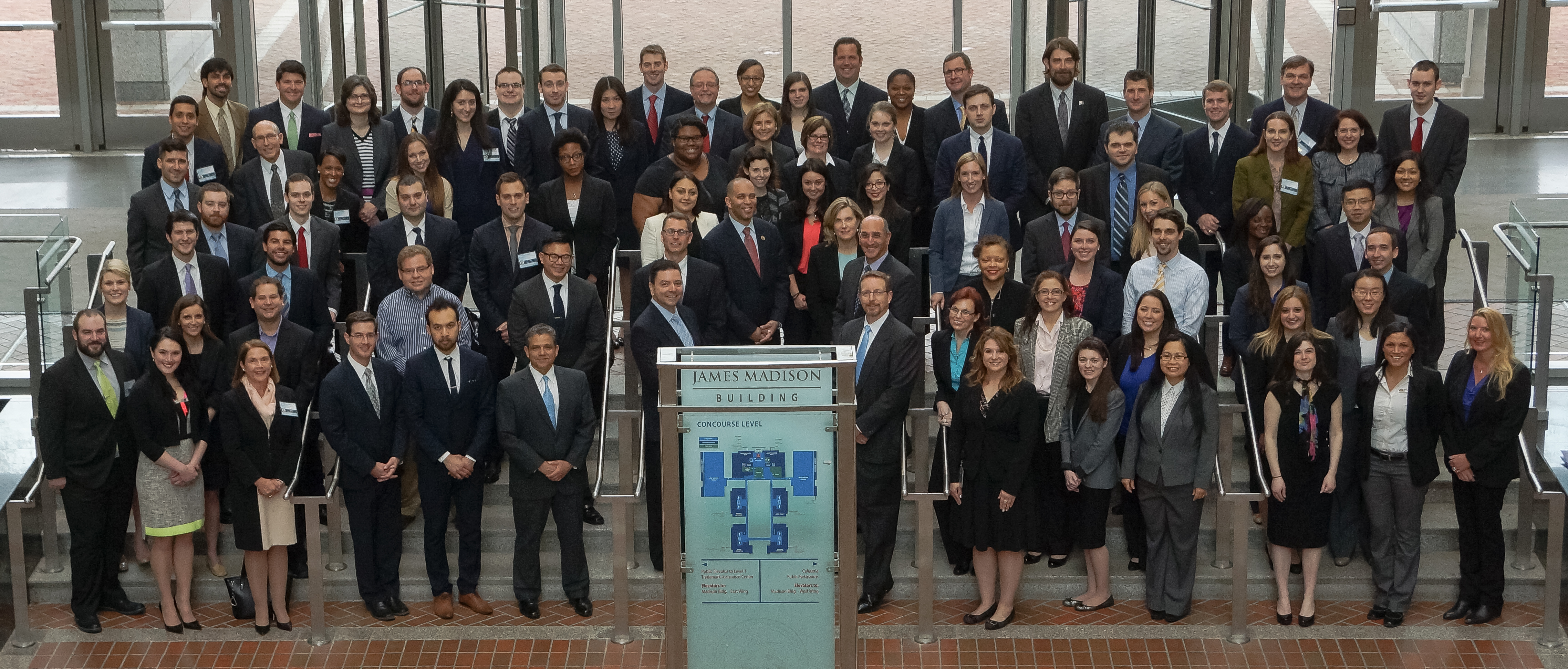
USPTO 4-15-2015 Law Clinic DSC00997 (group photo) Photographs by Michael A Cleveland DMS 2-6201 (2)

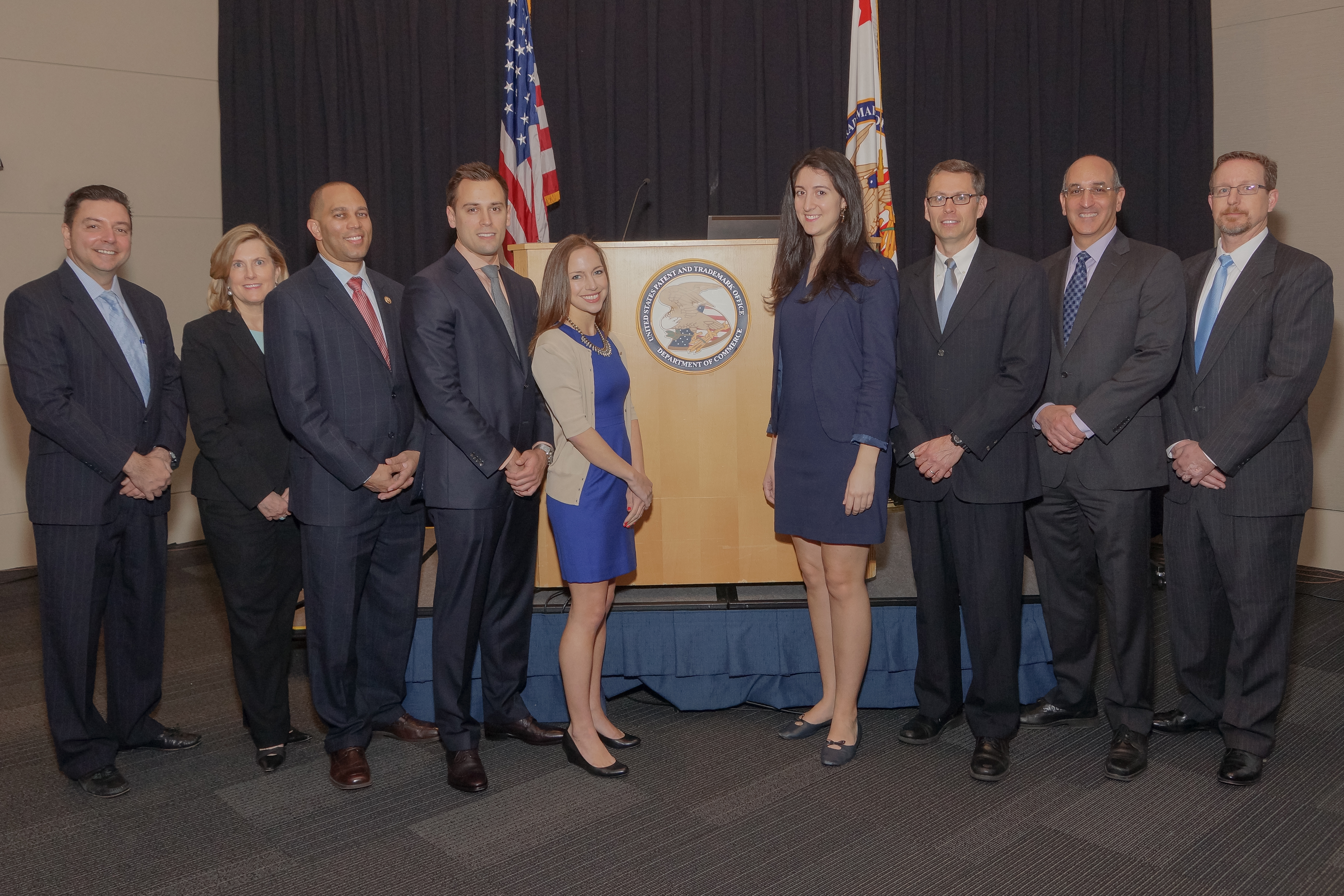
On April 15, Clinic student attorneys Charles Frank, Cori Stedman, Caile Morris, Alexandra El-Bayeh, Mark Patrick, and Jessica Rickman attended the Law School Clinic Certification Program Visit to the United States Patent and Trademark Office (USPTO). Representatives of several participating clinics from around the country were in attendance as well.

The day was quite eventful, as participants heard from Rep. Hakeem Jeffries (D-NY), who cosponsored a piece of legislation in 2014 that eliminated the program’s pilot status, making it more accessible to all ABA-accredited law schools. We then heard from Thomas Krause, Deputy Solicitor for Intellectual Property Law at the USPTO, who gave the Clinic a shout out for its work filing amicus briefs in Supreme Court cases, in response to a question from a professor at another law school who asked whether clinics have a role in the amicus process.

Attendees then broke out into round table discussions with PTAB judges, trademark examining attorneys, patent examiners, and others. Following lunch, we were fortunate to have a rare glimpse into a live TTAB opposition hearing, Caterpillar Inc. v. Rodney C. Kelly.

The afternoon wrapped up with presentations from a TTAB judge, the Deputy Commissioner for Patent Examination Policy, the Administrator for Trademark Policy and Procedure, and a PTAB judge. All in all, the student attorneys truly enjoyed themselves and were proud to represent the IP Clinic!

-Charles Frank 3L

unknown

USPTO 4-15-2015 Law Clinic DSC00972  Photographs by Michael A Cleveland DMS 2-6201

pto 2


Posted in Clinic News | Tagged , , , , | Comments Off on Law School Clinic Certification Program Visit to the United States Patent and Trademark Office

Washington ArtWorks Opening of Hang the Lawyers

On April 10th, 2015 Washington ArtWorks opened Hang the Lawyers, an exhibition of artwork created by attorneys and law students of the Washington, D.C. area. In partnership with Washington Area Lawyers for the Arts, the walls of Washington ArtWorks’ two galleries are  now filled with art of a variety of media. Hang the Lawyers is a unique exhibition no to be missed!  Former IP Clinic Practitioner Nabila Isa-Odidi Aguele was on hand to see her paintings on display.  Joining her was Ali Sternberg ’12.

Nabila and Ali

Nabila and Ali

 “Over 40 attorneys and law students are participating in the exhibition,” said Missy Loewe, CEO & President of Washington ArtWorks. “We had no idea there were so many creative lawyers in DC!”

Posted in Clinic News | Tagged , , , , | Comments Off on Washington ArtWorks Opening of Hang the Lawyers

Spring Pop Up Legal Clinic with WALA and GW scheduled for March 18th!

wala

The Glushko-Samuelson Intellectual Property Law Clinic, in collaboration with the Washington Area Lawyers for the Arts (WALA) and GW’s Small Business Clinic will hold another in its series of “Pop Up” Legal Clinics for creative artists and entrepreneurs seeking legal assistance.

The Pop Up Clinics provide legal consultations to individuals and businesses involved in the regions’ creative economy. Student attorneys from the WCL IP Clinic will provide assistance in copyright, patent, trademark and related fields.  Student attorneys from the GW Small Business Clinic will provide start-up corporate assistance in the area of small business development. All student attorneys will be supervised by WCL and GW law school clinical faculty.

The Clinic will be held from 5-7 PM at the offices of the GW Law School’s Small Business & Community Economic Development Clinic at 2000 G Street NW, Washington, DC.  Clients are asked to register on the WALA site at the link below–

http://waladc.org


Posted in Clinic News | Comments Off on Spring Pop Up Legal Clinic with WALA and GW scheduled for March 18th!