Clinic Students Help Community Radio Navigate World of Music Licensing

xlitejazz_logo.png.pagespeed.ic.ycn4qdwSXU[1]

The world of music licensing is opaque, confusing, and quite frankly, a mess. It involves the cooperation of countless parties, from music publishers and record labels, to performance rights organizations, service providers, and artists, to the Department of Justice and the Library of Congress. Senior attorneys still scratch their heads as they try to make sense of this fragmented, piecemeal regime.

Clinic student attorneys Charles Frank and Breanne Hoke were tasked with synthesizing some of this information for a client representing one facet of the music industry, radio. The radio industry, which started as a strictly commercial broadcast industry, has now morphed into something that encompasses numerous noncommercial entities, many of which operate as low-power FM stations (LPFMs) and use the Internet medium as a means of simulcasting their terrestrial broadcasts. Others exclusively use the Internet to reach their audiences, as an eleven-year-old term, the “podcast,” has now made its way back into contemporary vernacular.  The client, Prometheus Radio Project, is a non-profit organization that represents the interests of community radio stations across the nation. The students work was published on Prometheus’ website and the work has been shared and “liked” on social media by a wide range groups in the radio and music industry.

http://www.prometheusradio.org/musiclicensing

Posted in Clinic News | Tagged , , , | Comments Off on Clinic Students Help Community Radio Navigate World of Music Licensing

5 Things to Know About Clinic Recruiting for Next Year–

004_IP_Clinic_Reunion_2013

1) General clinic information meeting– Tues. 2/10 at 4:30 in Room 101.  The meeting will describe the clinical program generally.

2 ) For those interested in the IP Clinic–specialized information sessions will be held:

Wed 2/11, at 10am in Room 600

Mon 2/16, at 4:30pm in Room 524

AND JUST ADDED THURS. 2/19 AT NOON IN ROOM 600

3) The application schedule is accelerated this year – the deadline for applications is now 2/19, and decisions will be made by 2/27.

4) The IP clinic is going to try to take a handful of rising 2Ls this year–so interested 1Ls should definitely apply!

5) See ipclinic.org for much more information!


Posted in Clinic News | Comments Off on 5 Things to Know About Clinic Recruiting for Next Year–

Clinic Alum Zu Williams appointed to Bench in Maryland

05williams

Before leaving office, Maryland Governor O’Malley appointed 2003 IP Clinic alum Zuberi Williams to the District Court for Montgomery County.  Zu  has been serving as a Maryland Administrative Law Judge, presiding over administrative cases at over 30 state agencies. Previously, he worked as a trial attorney in Washington, D.C.’s Office of the Attorney General and as an associate at Venable, LLP. Zu also served as a law clerk to Judge Gerald Bruce Lee of the U.S. District Court for the Eastern District of Virginia and Maryland Chief Judge Robert M. Bell.  Zu cut his legal teeth in some testy depositions in an IP litigation in the clinic—congrats Zu!

Posted in Clinic News | Comments Off on Clinic Alum Zu Williams appointed to Bench in Maryland

HR 5108 Codifies USPTO Law School Clinic Pilot Program

uspto

H.R. 5108, the legislation to permanently establish the USPTO Law School Clinic Pilot Program, was passed by the Senate yesterday. The IP Clinic and clinic students were instrumental in early efforts to establish a student practice rule at the agency.

The bill will now go to the President for his signature. The bill, introduced in the House by Rep. Hakeem Jeffries of New York and Rep. Steve Chabot of Ohio, formally establishes the USPTO Law School Clinic Certification Program to allow students enrolled in a participating law school clinics to practice patent and trademark law at the agency under the guidance of a Law School Faculty Clinic Supervisor on a pro-bono basis for clients. It requires the USPTO Director to establish regulations and procedures for application to and participation in this program and makes all law schools accredited by the ABA eligible to participate if they meet program requirements.

The text of H.R.5108 and more information is on Thomas: https://congress.gov/bill/113th-congress/house-bill/5108

Press Release upon introduction of the House Bill: http://jeffries.house.gov/media-center/press-releases/reps-hakeem-jeffries-and-steve-chabot-introduce-bipartisan-legislation

House Rep. 113–588 on the bill: https://www.congress.gov/113/crpt/hrpt588/CRPT-113hrpt588.pdf

Posted in Clinic News | Tagged , , , , , , , , , | Comments Off on HR 5108 Codifies USPTO Law School Clinic Pilot Program

You Gotta Fight For the Right to Break Digital Locks: IP Clinic Teams Up with Cinema Studies Professor, Higher Education Organizations in DMCA Rulemaking

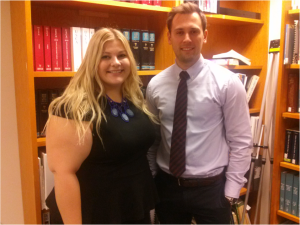
Guest post by student attorneys Sarah O’Connor and Mark Patrick

The Digital Millennium Copyright Act makes it illegal to break digital locks on copyrighted material, even when what you intend to do with the work is otherwise legal, such as using short clips from a motion picture in a class presentation. However, there is an out. Every three years the Copyright Office holds a proceeding to consider and grant limited exemptions for uses where users can show the law is creating a substantial burden on free expression or other valuable activities.

In each triennial proceeding, new petitions must be submitted on behalf of each party seeking exemptions. Petitions must make the case for what has been exempted in the past, in addition to what should be exempted in the present and future, keeping in mind new technological and pedagogical trends. Failure to submit these petitions every three years would result in a total loss of the exemption.

The Glushko-Samuelson Intellectual Property Law Clinic has had the exciting opportunity to work on several DMCA exemption petitions through the years and is again participating in this process. The previous petitions submitted by the IP Clinic involved a collaborative effort with educators and students. Securing these exemptions has assured that professors and students can continue to break digital locks and use short portions of audiovisual works. This year we have been working with Peter Decherney, Professor of Cinema Studies and English at the University of Pennsylvania, and organizations including the College Art Association, the International Communication Association, and the Society for Cinema and Media Studies to submit a petition asking for exemptions on behalf of college and university students and professors.

Mark+Sarah

The petition asks for an exemption for audiovisual works embodied in physical media (DVDs and Blu Ray) or obtained online. Audiovisual works is a relatively broad category that includes not only motion pictures but also television programs, slide shows, video games, and other works. This exemption would enable students and professors to use short portions or still images from these works to prepare a lecture or dissertation, facilitate a classroom discussion, complete an assignment, or otherwise participate in activity that enhances the educational experiences.

Once the petitions are submitted and reviewed, the Copyright Office will ask proponents of exemptions to make their case through compelling stories and other examples of the adverse effects imposed by this law. Have digital locks imposed a burden on you? Or, have you taken advantage of existing exemptions to legally copy from DVDs and other protected formats for teaching and learning? We are gathering evidence of the harmful impact that digital locks can have, and of the benefits of lawful access to media for use in teaching and learning, and we want to hear from you! If you have a story to share, please fill out our Google form! You can also get in touch with our student attorneys by email at so6921a@student.american.edu

Our petition and others can be seen at: http://copyright.gov/1201/2014/petitions/
The Electronic Frontier Foundation is also maintaining a list of petitions, as well as background info, blog posts and press releases which can be found here: https://www.eff.org/cases/2015-dmca-rulemaking.

Posted in Clinic News | Comments Off on You Gotta Fight For the Right to Break Digital Locks: IP Clinic Teams Up with Cinema Studies Professor, Higher Education Organizations in DMCA Rulemaking

Suzan Shown Harjo to receive Presidential Medal of Freedom on Monday

President Obama has named Suzan Shown Harjo (Cheyenne & Hodulgee Muscogee) a recipient of the Presidential Medal of Freedom. The Medal of Freedom, established by President Kennedy in 1963, is the nation’s highest civilian honor.  It is awarded to “individuals who have made especially meritorious contributions to the security or national interests of the United States, to world peace, or to cultural or other significant public or private endeavors.”  While there were many luminaries among the 19 awardees, Suzan Harjo, a great friend and colleague of the IP Clinic, is a model of what a recipient of this award can and should be.

Her work for justice for Native peoples has gone largely unheralded for decades—but her perseverance has been extraordinary. Unassisted by high profile board members, public relations experts, lobbying firms and black tie fundraisers, she has worked tirelessly for justice for Native peoples in efforts to reclaim their culture and their dignity.  Most of these efforts have simply asked for the return of what once belonged to the very cultures she represents.  Whether she is fighting for appropriated or misappropriated places, graves, remains , tribal property, names or imagery –the ask has been simple and consistent —dignity and respect for Native cultures and peoples.

Her name is most often associated with the successful trademark cancellation proceeding against the Washington football franchise, a request she initiated in 1992, but still tied up in federal court nearly 25 years later. Despite the recent notoriety of that particular issue, she had worked steadfastly for many years trying to convince the larger world of professional and scholastic sports to renounce the use of team names, mascots and imagery promoting negative stereotypes of Native Americans.   But her meritorious good works and quest for Native justice go well beyond those efforts.  Over her long career she has worked to preserve and protect Native sacred places, human remains, tribal sovereignty and cultural property.  Suzan was the driving force behind most of the important laws protecting Native American cultures and arts including the 1996 Executive Order on Indian Sacred Sites, the 1990 Native American Graves Protection and Repatriation Act, the 1989 National Museum of the American Indian Act, and the 1978 American Indian Religious Freedom Act.   Harjo serves as the president of the Morning Star Institute, an advocacy group she founded in 1984 for Native culture and education. She served as executive director of the National Congress of American Indians from 1984-1989 and continues to serve as co-chair of their subcommittee on Human, Religious, and Cultural Concerns.  She was also a founder of the National Museum of the American Indian and guest curator of the museum’s current exhibit  Nation to Nation: Treaties Between the United States and American Indian Nations.   She is also a prolific writer, poet, accomplished scholar and mother.  And, as we at the IP Clinic know, she is a truly wonderful friend and mentor.

The medal will be presented to Suzan by the President at a White House ceremony on Monday, November 24th.

Congratulations and AHO Suzan!

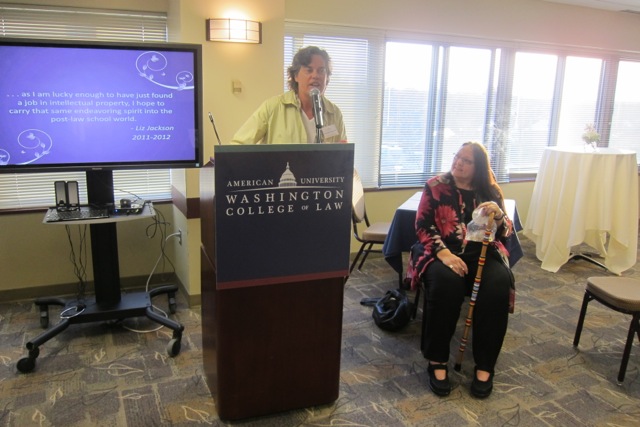
Suzan at the 2013 IP Clinic reunion

Suzan at the 2013 IP Clinic Reunion

Posted in Clinic News | Tagged , , , , , , , , , | Comments Off on Suzan Shown Harjo to receive Presidential Medal of Freedom on Monday

IP Clinic Announces “Pop Up Legal Clinic” for Creative Entrepreneurs to be held on Oct. 29th

wala

The Glushko-Samuelson Intellectual Property Law Clinic of WCL, in collaboration with the Washington Area Lawyers for the Arts (WALA) and George Washington University College of Law’s Small Business Clinic will hold another in its series of “Pop Up” Legal Clinics for creative entrepreneurs seeking legal assistance.

The Pop Up Clinics provide legal consultations to individuals and businesses involved in the regions’ creative economy. Student attorneys from the WCL IP Clinic will provide assistance in copyright, patent, trademark and related fields. GW student attorneys from the Small Business Clinic will provide start-up corporate assistance in the area of small business development.  All student attorneys will be supervised by WCL and GW law school clinical faculty.

Clients are asked to register at the link below–

http://waladc.org/2014/08/a-new-wala-live-creative-economy-legal-clinic-to-be-announced-for-fall/

The Pop Up Clinic will be held 5-7 PM on Wednesday, October 29th at the GW law school clinic offices at 2000 G Street NW in DC.

Another clinic will be held in the Spring.

Posted in Clinic News | Tagged , , , , | Comments Off on IP Clinic Announces “Pop Up Legal Clinic” for Creative Entrepreneurs to be held on Oct. 29th

Native Americans Seek Dismissal of Pro Football’s Lawsuit Over Cancellation of Washington Team’s Trademarks

Today Amanda Blackhorse and her co-defendants filed a motion to dismiss Pro Football’s complaint in federal court for lack of jurisdiction.  The defendants argue that although Pro Football and the Blackhorse Defendants sharply disagree over the U.S. Patent and Trademark Office ‘s decision to cancel the team’s trademark registrations as disparaging, there is no justiciable dispute remaining between them.  The “controversy” exists only between Pro Football and the government agency that cancelled the trademarks–the USPTO. Pro Football asserts no trademark ownership, infringement, or  other cause of action against the Native defendants. The motion points out that their dispute is ultimately only with the USPTO.

It is the USPTO – not the Blackhorse Defendants – that Pro Football claims has violated the Lanham Act and the Constitution in cancelling their trademarks. The relief Pro Football seeks is to prevent the final cancellation of the trademarks by the government. Pro Football seeks no relief against Amanda Blackhorse and her co-defendants and the federal complaint will not affect any of their legal or economic interests, no matter the outcome. The motion argues that Pro Football’s complaint should be dismissed for lack of jurisdiction because the defendants are not “parties in interest” against whom an action may be filed and there is no “case or controversy” for an Article III court to hear or resolve.

Ordinarily, the adverse parties in a trademark opposition or cancellation proceeding before the USPTO are businesses claiming rights to the same or similar trademarks. When a party dissatisfied with a decision of the USPTO brings actions under these same provisions, the party is usually involved in a dispute with a business that uses a similar trademark. It is clear in these cases that the other party using a similar and possibly infringing trademark is a “party in interest.”

This case is not that typical case. Here, the petition to cancel was not filed by a business with a trademark dispute, but by five Native Americans who sought cancellation of Pro Football’s trademarks on public interest grounds as provided for in the trademark laws.

Posted in Clinic News | Tagged , , , , , , , , , | Comments Off on Native Americans Seek Dismissal of Pro Football’s Lawsuit Over Cancellation of Washington Team’s Trademarks

Missing the Point: The Real Impact of Mascots on American Indian and Alaska Native Youth

Under the supervision of Prof. Victoria Phillips, the IP Clinic has been involved for the past several years in representing Native clients in the controversy surrounding the Washington NFL team’s disparaging trademark and related cultural issues.  We have had the great privilege to work with Suzan Harjo, the national leader on this effort.  Building on this work,  Prof. Phillips has co-authored a report with Erik Stegman at The Center for American Progress (CAP) titled “Missing the Point: The Real Impact of Mascots on American Indian and Alaska Native Youth.”  The report will be released at an event at CAP July 22, 1024 and examines the research on the mental health impacts of racist team names and mascots on AIAN youth, the effects on their education, and proposes new recommendations to local, state, and federal education agencies to tackle the problem.  It also features personal testimonials from AIAN youth about how these racist stereotypes affect their self-esteem and create hostile learning environments. The program rolling out the report will feature keynote remarks from Rep. Betty McCollum, followed by remarks from a young American Indian high school football player, and a panel of experts and tribal leaders.  Please join us or tune in to the webcast!

http://www.americanprogress.org/events/2014/07/14/93821/missing-the-point-the-real-impact-of-native-mascots-and-team-names-on-american-indian-and-alaska-native-youth/

Read the Report–

http://www.americanprogress.org/issues/race/report/2014/07/22/94214/missing-the-point/


Posted in Clinic News | Tagged , , , , , , , | Comments Off on Missing the Point: The Real Impact of Mascots on American Indian and Alaska Native Youth

Clinic publishes case studies of Native American mascot changes

Today the Glushko-Samuelson Intellectual Property Clinic at American University Washington College of Law is publishing a collection of case studies showing how four universities successfully retired and replaced mascots that play on Native American stereotypes. The studies, which examine mascot changes at Dartmouth College, Stanford University, University of Oklahoma, and Syracuse University, were prepared by student attorneys in the clinic during the 2012-2013 school year. These studies, which show how communities have ultimately embraced this change, may be of help to the Washington football team as it considers its options following the cancellation of its trademark.

Changing the Mascot at Dartmouth, Stanford, Oklahoma and Syracuse

Posted in Clinic News | Tagged , , , , , , | Comments Off on Clinic publishes case studies of Native American mascot changes